When reading a supplement or medicine label, most people focus on the active ingredients. These are the compounds associated with the intended benefit.
But nearly every capsule, tablet, or powdered product also contains excipients — substances traditionally described as “inactive.”
While excipients serve important manufacturing functions, they are not always irrelevant from a consumer health perspective.
What Are Excipients?
Excipients are ingredients added to formulations to:
• Improve powder flow
• Prevent clumping
• Aid capsule filling
• Stabilise sensitive compounds
• Extend shelf life
• Enhance appearance
They are widely used because they make large-scale manufacturing:
• Faster
• Easier
• More cost-efficient
• More technically predictable
Without excipients, producing consistent products becomes significantly more challenging.
The “Inactive” Misconception
The term inactive can be misleading.
Excipients may not deliver therapeutic effects, but they still:
• Interact with the body
• Contact the digestive tract
• Influence absorption dynamics
• Affect sensitive individuals differently
For many people, excipients pose no noticeable issues. For others — particularly those with sensitivities — they may matter more.
Silicon Dioxide (E551 / Synthetic Amorphous Silica)
One of the most common excipients in supplements is silicon dioxide, also known as:
• E551 (food additive designation)
• Synthetic Amorphous Silica (SAS)
Why is it used?
Silicon dioxide acts primarily as an anti-caking agent:
• Prevents powders from sticking
• Improves encapsulation efficiency
• Supports uniform dosing
• Reduces manufacturing costs
Because of these benefits, it appears in a very large percentage of supplements globally.
The Established Safety Position
Regulatory authorities such as:
• EFSA (European Food Safety Authority)
• FDA (U.S. Food and Drug Administration)
have classified food-grade silicon dioxide as safe within approved usage limits.
Most safety assessments historically evaluate:
• Bulk (non-nano) particles
• Typical dietary exposure
• Standard toxicology endpoints
Under these parameters, silicon dioxide is generally considered low risk.
Emerging Research and Nanoparticles
More recent scientific investigations have examined silicon dioxide nanoparticles (SiO₂ NPs) — extremely small particles that may arise during processing.
At nanoscale sizes, materials can behave differently biologically.
Some laboratory and animal studies have explored potential associations with:
• Oxidative stress
• Inflammatory responses
• Immune modulation
• Tissue accumulation under specific conditions
For example, research has suggested:
Different sizes and surface charges of silicon dioxide nanoparticles may produce varying biological effects, with smaller negatively charged particles showing more pronounced immune interactions in experimental models.
Interpreting the Science Responsibly
Context is important:
• Many findings are preclinical
• Doses may exceed typical intake
• Not all silicon dioxide contains nanoparticles
• Regulatory agencies continue to review evolving data
There is currently no universal regulatory prohibition against silicon dioxide in approved supplement use.
However, the science surrounding chronic exposure and nanoparticle behaviour continues to develop.
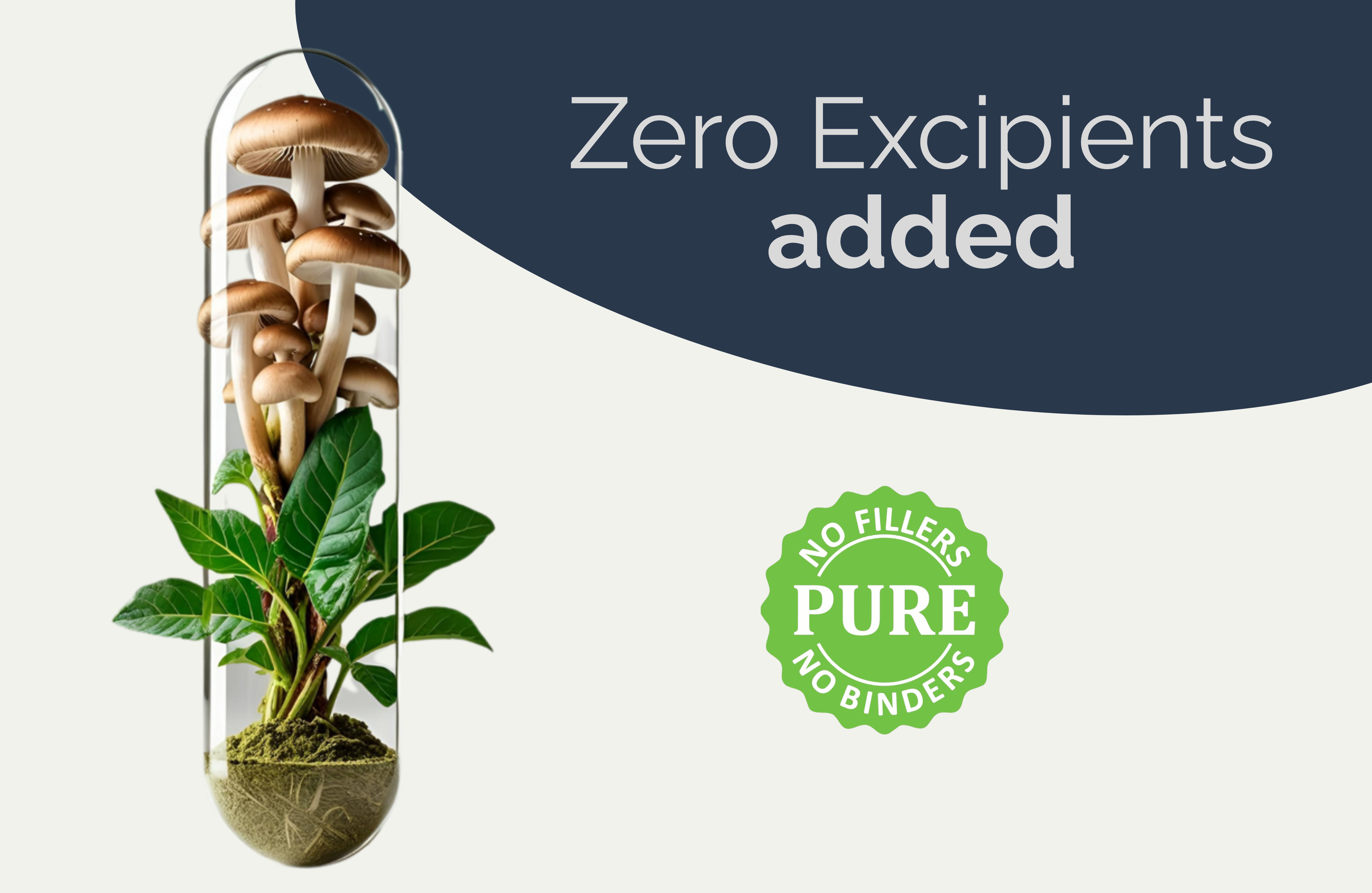
Why Medlife Products Are Excipent-Free
At Medlife Products, we have chosen a formulation philosophy based on purity and minimalism:
✔ No fillers
✔ No binders
✔ No flow agents
✔ Zero excipients
This decision reflects:
• A clean-label commitment
• Respect for sensitive individuals
• Avoidance of unnecessary additives
• A preference for ingredient transparency
The Manufacturing Reality
Creating excipient-free products is:
• Technically demanding
• Slower to manufacture
• Less forgiving in production
• More costly
Excipients exist for a reason — they simplify manufacturing.
Choosing to avoid them requires greater precision, stricter controls, and careful raw material handling.
Who May Prefer Excipent-Free Products?
While many consumers tolerate excipients well, some individuals intentionally limit them:
• People with digestive sensitivities
• Those with autoimmune concerns
• Individuals following clean-label lifestyles
• Consumers seeking additive-free products
A Balanced Perspective
Excipients are not inherently “bad.” They are:
• Regulated
• Extensively studied
• Functionally useful
But they are also not essential for everyone.
For consumers who prefer simplicity, formulations without excipients provide an alternative.
Final Thoughts
Understanding excipients empowers better decisions.
Whether you prioritise:
• Manufacturing convenience
• Regulatory consensus
• Ingredient minimalism
the key is informed choice.
At Medlife Products, our stance is clear:
Only active ingredients. Nothing unnecessary.